📊 CPM Calculator
What Is CPM? A Clear Definition
CPM stands for Cost Per Mille, where “mille” is the Latin word for one thousand. In advertising, it refers to the cost an advertiser pays — or a publisher earns — for every 1,000 ad impressions served. An impression is simply each individual instance of an ad being displayed to a user on a webpage, app, or platform CPM calculator.
Think of it this way: if you are running a banner ad on a news website and it costs $10 CPM, you are paying $10 for every 1,000 times that ad is shown to visitors — regardless of whether anyone clicks on it. CPM calculator
This makes CPM an impression-based pricing model, as opposed to click-based (CPC) or action-based (CPA) models. CPM is most useful when the primary goal of a campaign is brand visibility and awareness rather than direct conversions.
Why CPM Is Important for Advertisers and Publishers
Advertisers use CPM to compare the efficiency of different ad platforms and placements.
Publishers (bloggers, website owners) use CPM to understand how much revenue they earn per thousand page views.
Media buyers rely on CPM benchmarks to evaluate whether they are overpaying or getting a fair deal.
Digital marketers use CPM alongside CTR and CPC to build a complete picture of campaign performance.
The CPM Formula: How to Calculate the CPM
The formula to calculate the CPM is straightforward and easy to memorize:
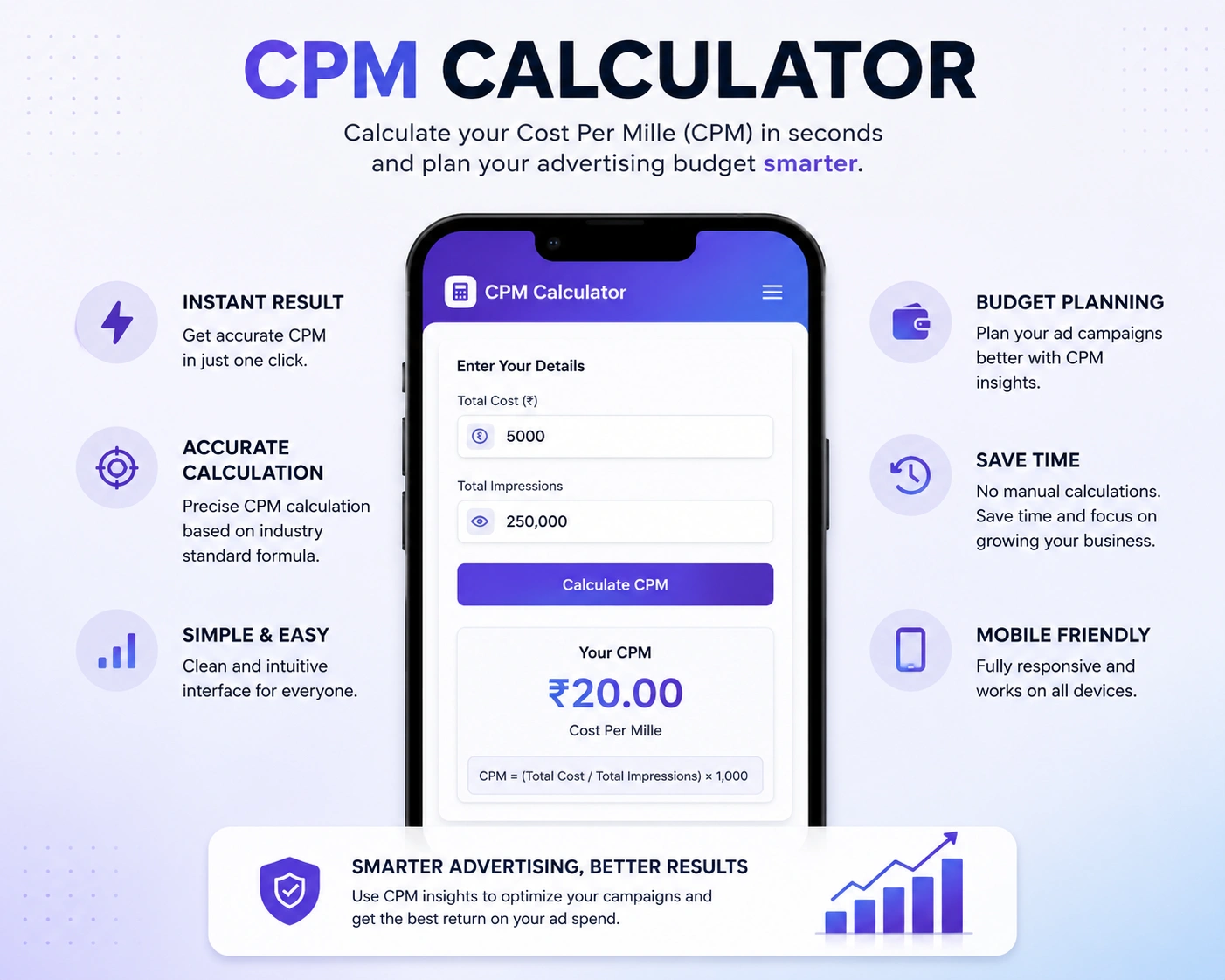
CPM = (Total Campaign Cost ÷ Total Impressions) × 1,000
Breaking this down:
Total Campaign Cost — The total amount you have spent (or plan to spend) on the ad campaign.
Total Impressions — The total number of times your ad was displayed.
× 1,000 — Because CPM measures cost per thousand, we multiply by 1,000 to normalize the figure.
The Three CPM Variations You Must Know
Depending on what you are trying to calculate, you may need one of three versions of the CPM formula:
What to Calculate Formula When to Use
CPM CPM = (Cost ÷ Impressions) × 1,000 When you know cost & impressions
Total Cost Cost = (CPM × Impressions) ÷ 1,000 When planning a budget
Impressions Impressions = (Cost ÷ CPM) × 1,000 When setting reach goals
Step-by-Step CPM Calculation Examples
Example 1: Calculate the CPM of a Campaign
Scenario: You ran a Facebook ad campaign, spent $250 total, and your ad was shown 50,000 times.
Total Cost = $250
Total Impressions = 50,000
CPM = ($250 ÷ 50,000) × 1,000 = $5.00
Result: Your CPM is $5.00, meaning you paid $5 for every 1,000 impressions.
Example 2: Calculate Total Cost from CPM
Scenario: You want to buy a YouTube pre-roll ad with a CPM of $15. Your target reach is 500,000 impressions.
CPM = $15
Impressions = 500,000
Cost = ($15 × 500,000) ÷ 1,000 = $7,500
Result: Your total campaign cost would be $7,500.
Example 3: Calculate Impressions from Budget
Scenario: You have a $1,000 budget and the Google Display Network offers a CPM of $2.50. How many impressions can you buy?
Total Cost = $1,000
CPM = $2.50
Impressions = ($1,000 ÷ $2.50) × 1,000 = 400,000
Result: Your $1,000 will get you 400,000 impressions.
CPM vs CPC vs CPA: Key Differences
When budgeting an ad campaign, you will encounter three main pricing models. Here is how they compare:
Model Full Name You Pay For Best For
CPM Cost Per Mille 1,000 Impressions Brand awareness
CPC Cost Per Click Each Click Traffic generation
CPA Cost Per Action Each Conversion Direct sales/leads
The right model depends on your campaign goals. For pure visibility and reach — such as launching a new product or building brand recognition — CPM is usually the most efficient choice. When you want to drive specific traffic, CPC works better. When you are measuring revenue-generating actions like purchases or sign-ups, CPA is your best metric.
Average CPM Rates by Platform in 2026
One of the most common questions marketers ask is “what is a good CPM?” The honest answer is that it depends on your platform, industry, target audience, and ad format. However, here are realistic benchmark ranges for 2025:
Platform Avg CPM Range Notes
Google Search Ads $30 – $50 High-intent audience, very competitive
Google Display Network $2 – $5 Lower intent, good for awareness
Facebook / Instagram $7 – $12 Strong targeting, varies by audience
YouTube Pre-roll $10 – $30 High engagement, skippable vs non-skip
TikTok Ads $6 – $10 Growing platform, younger demographics
LinkedIn Ads $30 – $60 B2B niche, highest CPM overall
AdSense (Gaming/APK) $1 – $3 Lower advertiser demand in niche
AdSense (Finance) $15 – $40 Premium niche, high advertiser bids
Notice that gaming and app niches (like APK blogs) tend to have relatively lower CPM rates. This is because advertisers in that space bid less aggressively than finance or legal advertisers. However, high traffic volume can compensate for lower CPM, especially when combined with strategic content and proper ad placement optimization.
eCPM vs CPM: What Is the Difference?
You may also encounter the term eCPM (Effective CPM), especially in publisher-side tools like Google AdSense. While CPM is a pricing model set by advertisers, eCPM is a performance metric calculated after the fact.
eCPM = (Total Earnings ÷ Total Impressions) × 1,000
For example, if your blog earned $45 from 15,000 ad impressions, your eCPM would be ($45 ÷ 15,000) × 1,000 = $3.00. eCPM helps publishers compare the revenue efficiency of different ad placements, networks, or content pages.
How to Lower Your CPM and Maximize ROI
A high CPM is not always a problem — if your conversion rate is strong, paying more per impression can still be profitable. But if you want to stretch your budget further, here are proven tactics to lower your cost per thousand impressions:
1. Refine Your Target Audience
Broad targeting wastes budget on irrelevant users. Narrowing your audience by demographics, interests, location, and device type reduces wasted impressions and often lowers CPM by reducing competition from less-relevant advertisers.
2. Improve Your Ad Relevance Score
Platforms like Facebook and Google reward ads that perform well with lower CPMs. A higher Quality Score (Google) or Relevance Score (Facebook) means the platform prioritizes your ad over competitors, often at lower cost.
3. Test Multiple Ad Formats
Banner ads, native ads, video ads, and interstitials all have different CPM rates. Testing formats helps you find the sweet spot between reach and cost-efficiency.
4. Use Programmatic Advertising Wisely
Programmatic platforms let you set CPM bids more precisely. Use frequency capping to avoid showing the same ad too many times to the same user — this reduces waste and lowers effective CPM.
5. Choose the Right Time and Device
CPM fluctuates by time of day and device type. Mobile traffic often has a lower CPM than desktop. Running ads during off-peak hours can reduce costs for awareness campaigns where timing is less critical.
Common Mistakes When Calculating CPM
Confusing Impressions with Reach
Impressions count how many times an ad was shown total — including repeat views by the same user. Reach counts unique users who saw the ad. CPM is based on impressions, not reach. Using reach in the CPM formula gives you an inflated (incorrect) CPM figure.
Ignoring Viewability
Not all impressions are viewable — some ads load below the fold and are never actually seen. Industry standards define a viewable impression as 50% of the ad being visible for at least one second. Always check your viewability rate when evaluating CPM efficiency.
Comparing CPMs Across Different Ad Sizes
A 300×250 banner and a 970×250 billboard have very different CPMs. Comparing them directly without accounting for format differences leads to flawed conclusions.
Not Accounting for Ad Fraud
Bot traffic inflates impression counts without delivering real-value views, artificially lowering apparent CPM while reducing true ROI. Use tools like IAS, DoubleVerify, or platform-level fraud protection to filter invalid traffic.
CPM Calculator Tools You Can Use Today
Manually calculating CPM every time you plan a campaign gets tedious. Here are reliable tools that simplify the process:
Google Ads — Built-in CPM forecasting in the campaign planner
Facebook Ads Manager — Real-time CPM reporting in the dashboard
SEMrush — Competitive CPM intelligence and ad research
SpyFu — Competitor ad spend and CPM analysis
Omnicalculator CPM Tool — Free online CPM calculator for quick calculations
Search Engine Land CPM Calculator — Another reliable free tool
The interactive CPM calculator at the top of this page allows you to calculate CPM, total cost, or total impressions with a single input — no signup required.
CPM in Content Marketing and SEO
Even if you are not running paid ads, understanding CPM is valuable for content marketers and SEO professionals. If you are monetizing a website through display advertising, your eCPM directly determines your revenue per page view.
For a blog in the gaming or APK niche, a typical eCPM might sit around $1.50 to $3.00. At 100,000 monthly pageviews with two ad units per page (200,000 impressions), that translates to roughly $300–$600 per month from display ads alone.
Growing your eCPM requires not just increasing traffic, but attracting the right traffic. Visitors from the United States, United Kingdom, Canada, and Australia command far higher CPMs than traffic from South Asia or Southeast Asia, because advertisers in English-speaking markets bid more aggressively.
This is why targeting long-tail, high-intent keywords — even in a niche like mobile gaming — and optimizing for Tier 1 country traffic can significantly increase your ad revenue without adding new content.
FAQS
A: For display advertising, a CPM between $1 and $5 is typical for non-premium placements. Premium placements and high-value niches like finance or insurance can see CPMs of $20 or higher
A: Not necessarily. A high CPM can indicate a highly targeted, competitive audience that converts well. Always evaluate CPM alongside conversion rate, CPC, and ROI rather than in isolation.
A: RPM (Revenue Per Mille) is a publisher-side metric used by Google AdSense. While eCPM measures gross ad revenue per 1,000 impressions, RPM accounts for all revenue sources per 1,000 page views, making it a slightly different calculation.
A: Yes. Facebook, Instagram, LinkedIn, TikTok, and Twitter all use CPM as a standard bidding option. Social media CPMs are influenced by audience size, competition, creative quality, and your relevance score on the platform.
Final Thoughts
Learning how to calculate the CPM is one of the most practical skills you can develop as a digital marketer or website monetizer. The formula is simple — (Cost ÷ Impressions) × 1,000 — but the insights it unlocks are powerful. From planning ad budgets and forecasting reach, to benchmarking performance and optimizing revenue, CPM sits at the heart of nearly every advertising decision.
The key takeaway is this: never look at CPM in isolation. Pair it with CTR, conversion rate, and ROI to build a full picture of campaign performance. A $30 CPM that drives $300 in sales is far more valuable than a $2 CPM that drives nothing.
Use the CPM calculator above to run your own numbers, bookmark this guide as a reference, and start making more data-driven decisions with every campaign you run.
